
What Is the Difference Between IB Math AA and AI?
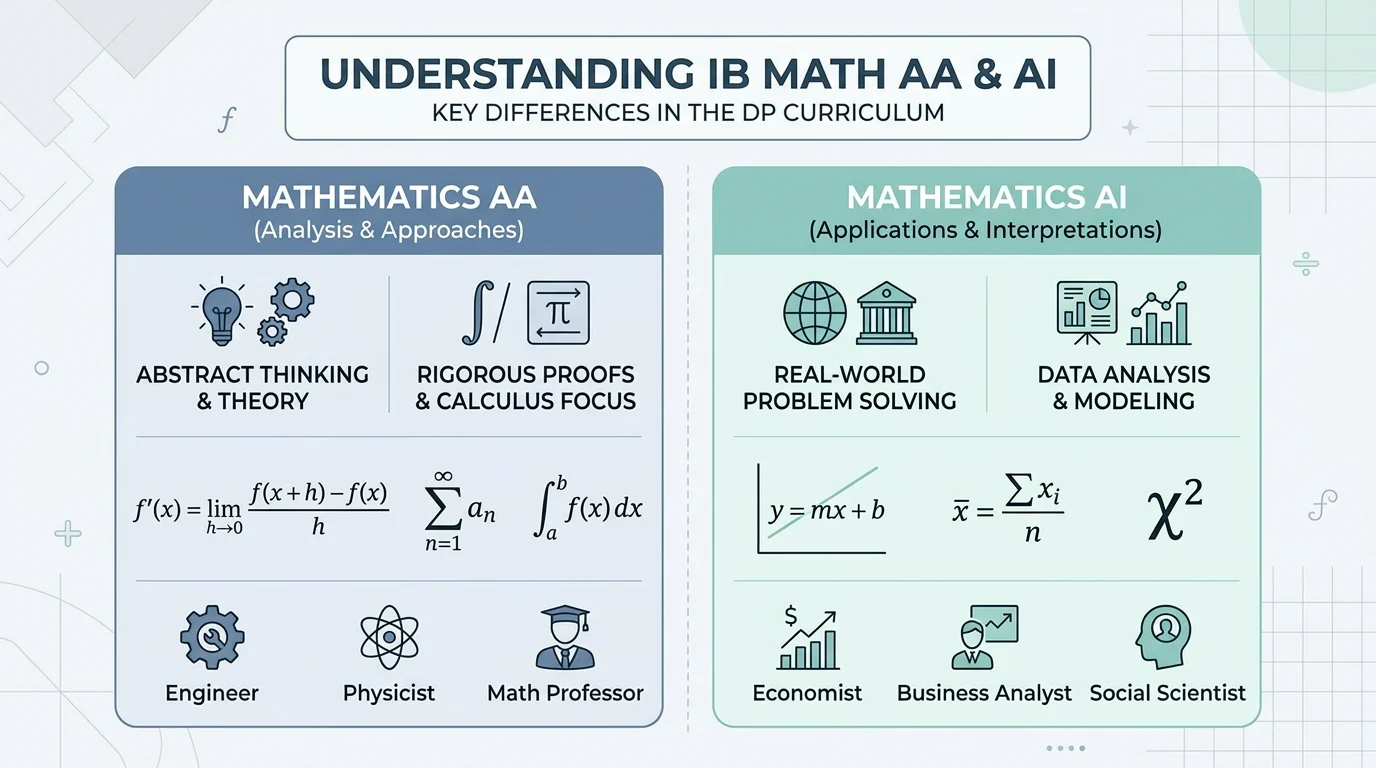
The two courses were introduced in 2021 to replace the old IB Math HL, SL, and Math Studies programmes. They share a common foundation but diverge significantly in depth, emphasis, and exam structure.
| Feature | Math AA | Math AI |
|---|---|---|
| Primary focus | Calculus, algebra, pure maths | Statistics, probability, modelling |
| Technology use | No calculator on Paper 1 | Calculator permitted on all papers |
| Best suited for | Engineering, physics, mathematics | Economics, psychology, design |
| Teaching style | Proofs and theoretical frameworks | Project-based, data-driven tasks |
For a detailed breakdown of the AA syllabus, see our IB Math AA programme page.
Should You Choose HL or SL?
Both pathways are offered at Standard Level (SL) and Higher Level (HL). SL requires 150 guided learning hours; HL requires 240 hours and includes a third exam paper with more advanced content. The jump from SL to HL is significant — HL students encounter complex numbers, further calculus, and multi-step abstract proofs that go well beyond the SL syllabus.
Choosing HL means accepting a heavier workload across an already demanding six-subject programme, so it is worth mapping out your realistic weekly study hours before committing.
Hong Kong Enrollment Statistics
The IB does not publish a Hong Kong-specific AA vs AI breakdown, but we can estimate local numbers by applying the May 2025 global subject split to Hong Kong’s total of 2,630 IB candidates that session.
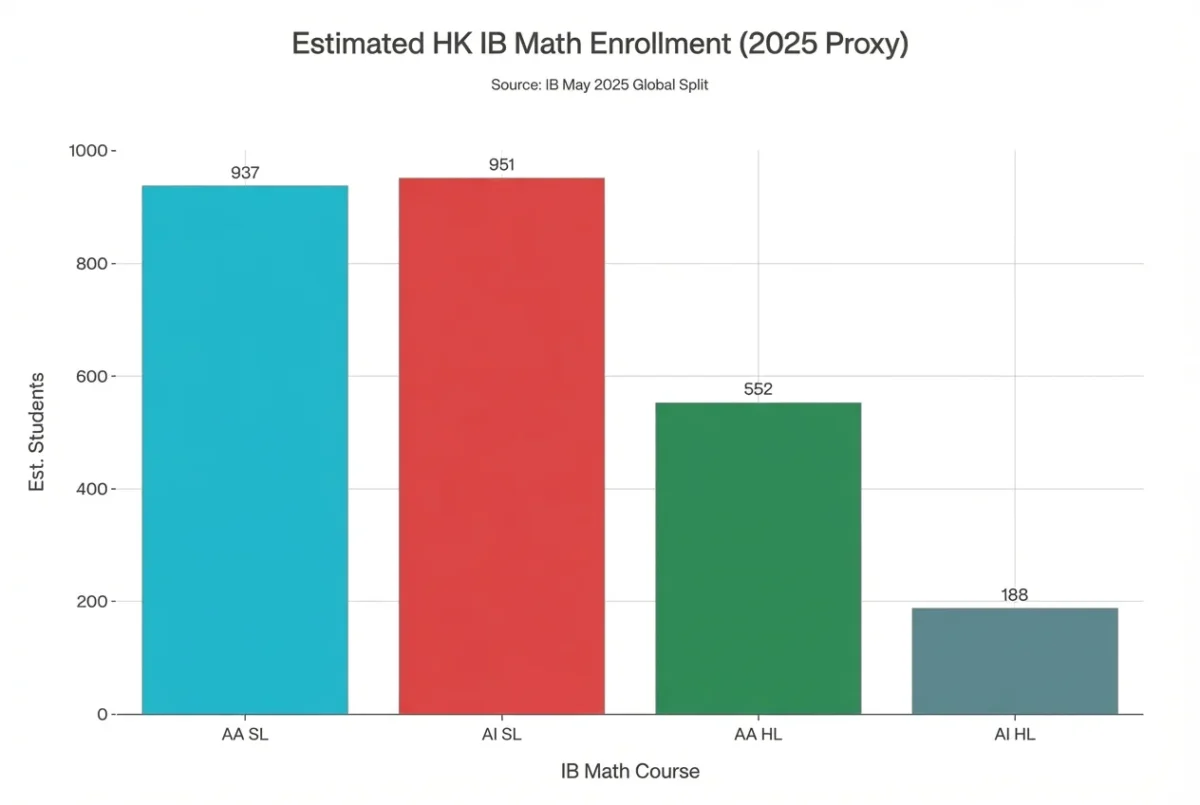
- Math AI SL is the most popular option globally at roughly 36.2% of entries — an estimated 952 students in Hong Kong.
- Math AA SL follows closely at 35.6% — an estimated 936 students.
- Math AA HL accounts for 21.0% of entries, making it the dominant HL choice for STEM-focused students — an estimated 552 students.
- Math AI HL remains the least common at just 7.2% of entries — an estimated 189 students across Hong Kong.
The Rise of Math AI HL
IB Math AI HL is still the least commonly chosen of the four options, largely because many schools and families default to more traditional pathways when targeting highly selective universities. However, this is beginning to change in Hong Kong.
Having taught IB Mathematics since the new syllabuses launched in 2021, I witnessed this shift first-hand. I had no AI HL students at all in that first year — the course was new and few families knew enough about it to seek it out specifically. My first AI HL enquiries came in 2022, and demand has grown steadily every year since. What stands out is that families are now actively asking for a tutor who specialises in AI HL rather than defaulting to an AA HL tutor — a sign of growing awareness that the two courses require genuinely different expertise. AI HL is heavier on statistics, modelling, and technology use than anything in the traditional IB curriculum, and it rewards a different kind of mathematical thinking. For a full breakdown of what the course involves, see the IB Math AI programme page.
What to Expect in Each Course
Students who have completed both routes frequently note that the difficulty gap between AA and AI is smaller than expected, particularly at Higher Level where both courses demand sustained, rigorous problem-solving.
In an AA classroom, you will spend more independent time mastering algebraic manipulation and constructing formal mathematical proofs. Paper 1 is completed entirely without a calculator, which means mental arithmetic and precise hand-worked algebra are essential from day one. Most AA Internal Assessment (IA) projects explore a pure mathematical concept — extending a theorem, investigating a number-theory property, or proving a geometric result.
In an AI classroom, lessons tend to be collaborative and technology-driven, with heavy use of GDC calculators, statistical software, and real data sets. You will work regularly with spreadsheets, regression models, and hypothesis testing from the start. AI IA projects are typically applied — modelling population growth, analysing sports data, or optimising a real-world logistics scenario.
Which Course Suits You? A Quick Decision Guide
Answer these four questions to narrow down your best option:
- Do you enjoy mathematical proofs and abstract problem-solving?
Yes → lean towards AA. No → lean towards AI. - Does your target university programme require Math AA HL?
Yes (engineering, physics, maths degrees) → choose AA HL. No → continue below. - Do you prefer working with data, statistics, and real-world contexts?
Yes → AI is likely the better fit. No → AA may still suit you better. - How heavy is the rest of your IB subject load?
Already taking 3 HL subjects with heavy workloads → consider whether SL gives you enough breathing room to maintain strong grades across all six subjects.
Still unsure? Book a free consultation with one of our IB specialists — we will help you map out the best combination based on your university goals and strengths.
University Entry Requirements
For 2026 university entry, the most important question is not which course is harder — it is which course is required. The table below summarises typical IB Mathematics requirements for popular degree programmes across Hong Kong and UK institutions.
| Degree Programme | Typical Math Requirement | Notes |
|---|---|---|
| Engineering (HKU, HKUST, Imperial, Cambridge) | Math AA HL 6–7 | Firm requirement at most institutions |
| Physics / Mathematics (HKU, CUHK, UCL) | Math AA HL 6–7 | AA HL virtually always required |
| Computer Science (HKUST, Imperial) | Math AA HL preferred | Some accept AI HL; check per institution |
| Economics — quantitative (LSE, HKUST) | Math AA HL preferred | AI HL may be accepted for general economics |
| Medicine (HKU, CUHK) | AA SL or AI SL/HL | HL maths not typically required |
| Business / Commerce (HKU, CUHK) | AA SL or AI SL/HL | No HL maths requirement |
| Psychology / Social Sciences | AA SL or AI SL/HL | No specific maths preference |
| Law | IB Diploma only | No subject-specific maths requirement |
Always verify the specific mathematics requirement for each programme directly on the university’s admissions page before making your final choice — requirements can change year to year.
Students currently in Years 9–11 preparing for IGCSE before entering the IB Diploma Programme can find detailed preparation guidance on our IGCSE maths tutoring page.
Unsure which course is the right fit for your target degree? Book a free consultation and get personalised advice based on your goals.
Explore Related Programmes
Many IB students in Hong Kong also prepare for additional exams alongside their diploma:
- IGCSE Mathematics — for students in Years 10–11 preparing to enter the IB Diploma Programme
- A-Level Mathematics — a common alternative pathway for UK university applicants
- SAT Math — required alongside IB for many US university applications
- AP Calculus — some IB students take AP exams for additional college credit
