
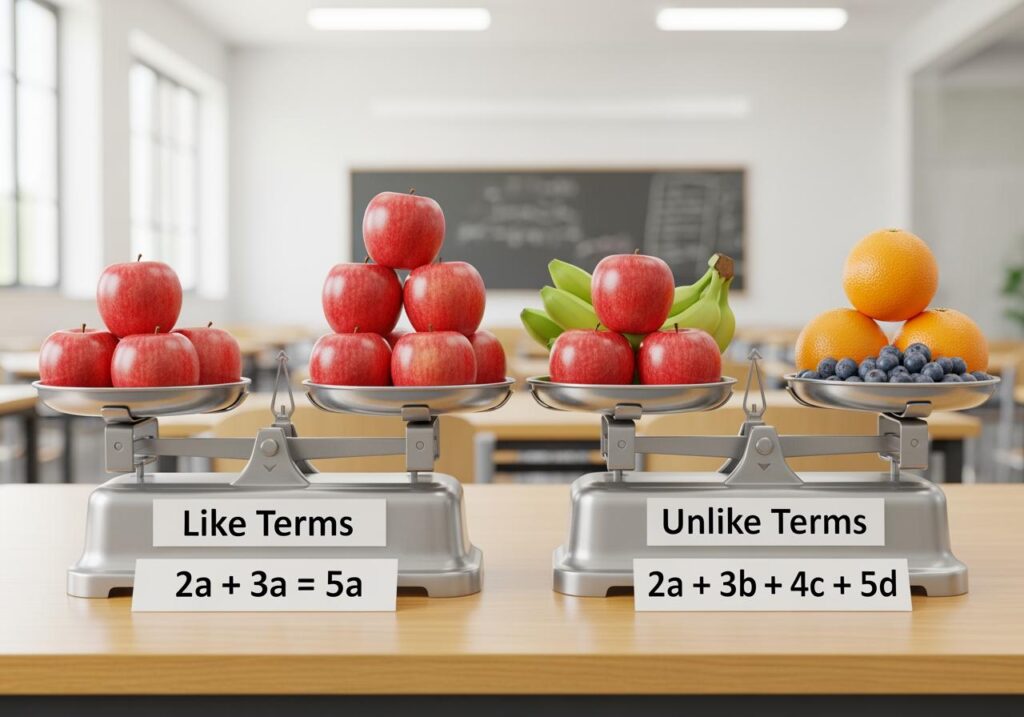
Like Terms vs. Unlike Terms: Simplifying Algebra
Learn how to sort and simplify algebraic expressions by grouping matching variables.
🎯 Lesson Hook: Imagine you have a basket of fruit with apples and bananas. To count them, you wouldn’t say “I have 5 fruit-things.” You would say “I have 3 apples and 2 bananas.” Algebra works exactly the same way!
In this lesson, you will learn how to sort and combine algebraic terms just like sorting fruit.
1. What is a Term? 🧱
Before we can sort them, we need to know what a term is. In algebra, an expression is made up of terms separated by plus ($+$) or minus ($-$) signs.
Look at this expression:
$$3x + 5y – 7$$
It has three distinct parts, or terms:
- $[[mathbf{3x}]]$ (a term with a variable)
- $[[mathbf{5y}]]$ (a term with a different variable)
- $[[mathbf{-7}]]$ (a constant term, just a number)
Every term has two main parts:
- The Coefficient: The number part (including the sign!).
- The Variable Part: The letter(s) and their powers.
2. The Golden Rule of Like Terms 🌟
You can only combine terms if they are “Like Terms.” But what makes them alike?
The Golden Rule:
Terms are Like Terms if they have:
1. The SAME variable(s)
2. The SAME exponent (power)
The number in front (the coefficient) does not matter when deciding if terms are like or unlike.
Examples of Like Terms ✅
These match perfectly in their variable parts:
- $2x$ and $5x$ (Both have just $x$)
- $3y^2$ and $-8y^2$ (Both have $y^2$)
- $ab$ and $4ab$ (Both have $ab$)
Examples of Unlike Terms ❌
These do not match:
- $x$ and $y$ (Different letters)
- $x$ and $x^2$ (Same letter, but different powers!)
- $5$ and $5x$ (One is a number, one has a variable)
3. Simplifying Expressions 🧮
Once you find like terms, you can simplify the expression by combining them. This is often called “collecting like terms.”
To combine like terms, you simply add or subtract their coefficients (the numbers in front) and keep the variable part exactly the same.
Example: Simplify $4a + 3a$
Since both terms have an $a$, they are like terms.
Think: 4 apples + 3 apples = 7 apples.
Math: $4 + 3 = 7$, so the answer is $[[mathbf{7a}]]$.
Watch out for signs! The sign in front of the term belongs to that term.
Example: Simplify $5x + 2y – 3x + 6y$
Step 1: Group the $x$’s.
$5x – 3x = 2x$
Step 2: Group the $y$’s.
$+2y + 6y = +8y$
Step 3: Put it together.
$$2x + 8y$$
💡 Pro Tip: You cannot combine the final $2x$ and $8y$ because they are unlike terms. That is your final answer!
Practice Problems
Try these practice problems to test your skills in identifying and combining like terms.
Problem 1: Identify the like terms in this list: $3x, 4y, -2x, x^2, 7$.
Show Answer
Step 1: Look at the variable part of each term.
We have $x$, $y$, $x$, $x^2$, and no variable.
Step 2: Find the matches.
$3x$ has the variable $x$.
$-2x$ has the variable $x$.
Note: $x^2$ is different because of the power!
Answer: The like terms are $[[mathbf{3x}]]$ and $[[mathbf{-2x}]]$.
Problem 2: Simplify the expression: $7m + 5 - 3m + 2$.
Show Answer
Step 1: Group the terms with $m$.
$7m - 3m = 4m$
Step 2: Group the constant numbers.
$+5 + 2 = +7$
Step 3: Combine the results.
The simplified expression is $[[mathbf{4m + 7}]]$.
Problem 3: Simplify: $4a + 3b + 2a - b$.
Show Answer
Step 1: Combine the $a$ terms.
$4a + 2a = 6a$
Step 2: Combine the $b$ terms.
Remember that $-b$ is the same as $-1b$.
$3b - 1b = 2b$
Step 3: Write the final expression.
$$6a + 2b$$
Interactive Quiz
Take this quick quiz to see if you've mastered like and unlike terms!