
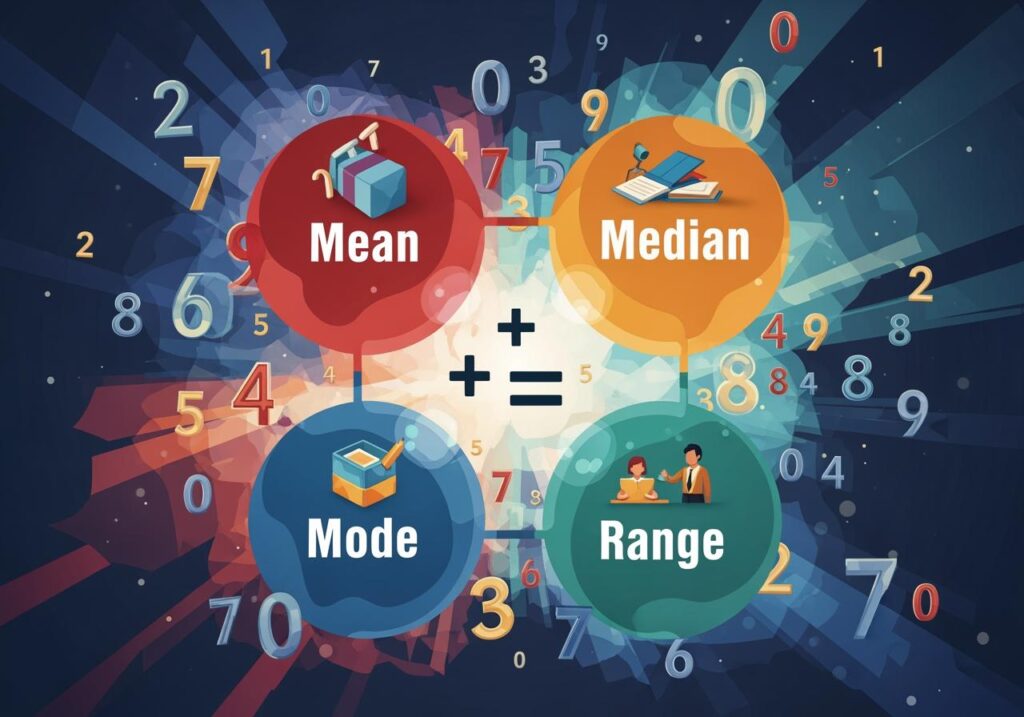
Mean, Median, Mode, and Range
Master the "Three M's" of averages and measure the spread of data.
🎯 The Big Idea: When we have a list of numbers (data), we often want to summarize them with a single value. We call these “averages” or measures of central tendency. We also want to know how spread out the numbers are.
- Mean: The mathematical average.
- Median: The middle number.
- Mode: The most frequent number.
- Range: The difference between the biggest and smallest.
1. The Mean (The Mathematical Average)
The mean is what most people think of when they hear the word “average.” It represents a “fair share” if all the values were distributed equally.
Formula for Mean:
$$ \text{Mean} = [[frac{\text{Sum of all values}}{\text{Total number of values}}]]$$
To find the mean, follow these two steps:
- Add up all the numbers.
- Divide by how many numbers there are.
Example: Test Scores
A student scores $70$, $80$, and $90$ on three tests. What is the mean score?
Step 1: Add the numbers.
$$70 + 80 + 90 = 240$$
Step 2: Divide by the count ($3$).
$$240 [[div]] 3 = [[mathbf{80}]]$$
The mean score is $80$.
2. The Median and Mode
Sometimes the mean can be misleading, especially if one number is way bigger than the rest. That’s why we have the Median and the Mode.
The Median (The Middle)
The median is the middle value in a list of numbers. To find it, you must put the numbers in order from smallest to largest first.
Case 1: Odd amount of numbers
Find the median of: $3, 9, 1$.
Step 1: Order them.
$1, [[mathbf{3}]], 9$
Step 2: Pick the middle one.
The median is $[[mathbf{3}]]$.
Case 2: Even amount of numbers
Find the median of: $2, 5, 8, 10$.
Step 1: Order them (already done).
$2, \underline{5, 8}, 10$
Step 2: Find the middle. There are two numbers in the middle ($5$ and $8$).
Step 3: Find the mean of those two numbers.
$$5 + 8 = 13$$
$$13 [[div]] 2 = [[mathbf{6.5}]]$$
The median is $6.5$.
The Mode (The Most Popular)
The mode is the number that appears most often. It is the easiest to spot!
- If no number repeats, there is no mode.
- If two numbers tie for the most appearances, the data is bimodal (two modes).
Find the mode of: $4, 1, 4, 6, 9$.
The number $4$ appears twice. Everything else appears once.
The mode is $[[mathbf{4}]]$.
3. The Range (The Spread)
The range is not an average. It tells us how spread out the data is. A big range means the data is very scattered; a small range means the data is consistent.
Formula for Range:
$$ \text{Range} = \text{Highest Value} – \text{Lowest Value} $$
Find the range of: $10, 2, 50, 15$.
Step 1: Identify the highest ($50$) and lowest ($2$).
Step 2: Subtract.
$$50 – 2 = [[mathbf{48}]]$$
The range is $48$.
Practice Problems
Practice finding all four values for the following data sets.
Problem 1: Find the Mean, Median, Mode, and Range for this set of numbers:
$$6, 3, 9, 6, 1$$
Show Answer
1. Ordering the Data:
First, let's put them in order: $1, 3, 6, 6, 9$.
2. Mean:
Sum: $1 + 3 + 6 + 6 + 9 = 25$
Count: $5$ numbers
Calculation: $25 [[div]] 5 = [[mathbf{5}]]$
3. Median:
The middle number in the ordered list ($1, 3, [[mathbf{6}]], 6, 9$) is $6$.
4. Mode:
The number $6$ appears twice. It is the most frequent.
Mode: $[[mathbf{6}]]$
5. Range:
Highest ($9$) - Lowest ($1$)
Range: $9 - 1 = [[mathbf{8}]]$
Problem 2: Find the Median of this set (even number of items):
$$10, 40, 20, 50$$
Show Answer
Step 1: Order the numbers.
$10, 20, 40, 50$
Step 2: Find the middle.
Since there are 4 numbers, the middle is between $20$ and $40$.
Step 3: Average the middle two.
Sum: $20 + 40 = 60$
Divide by 2: $60 [[div]] 2 = [[mathbf{30}]]$
The median is $[[mathbf{30}]]$.
Interactive Quiz
Test your knowledge of the averages and range!