
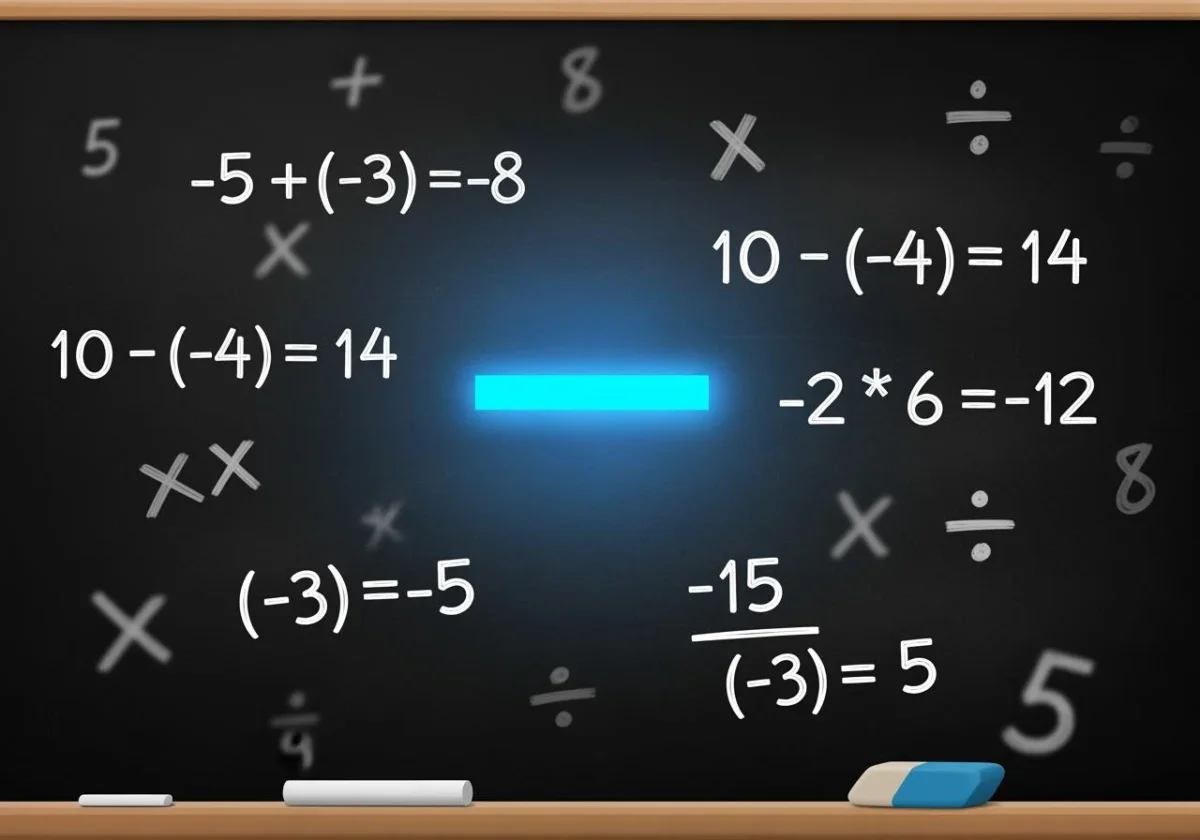
Mastering Operations with Negative Numbers
Understand the rules for calculating with positive and negative integers.
Negative numbers are numbers less than zero. They are like owing money or temperatures below freezing! ❄️ In this lesson, we will learn the rules for adding, subtracting, multiplying, and dividing positive and negative integers.
1. Adding and Subtracting Negatives
Think of a number line. Positive numbers go to the right, and negative numbers go to the left. When we add or subtract, we are just moving along this line.
The Double Sign Rules 🚦
When two signs appear next to each other, they combine into one sign:
- Plus and Plus becomes a Plus ($+ \, + \, [[rightarrow]] \, +$)
- Minus and Minus becomes a Plus ($- \, – \, [[rightarrow]] \, +$)
- Plus and Minus becomes a Minus ($+ \, – \, [[rightarrow]] \, -$)
- Minus and Plus becomes a Minus ($- \, + \, [[rightarrow]] \, -$)
Memory Trick: If the signs are the same, the result is positive. If they are different, the result is negative.
Let’s look at some examples of how to apply these rules.
Example 1: Adding a Negative
Calculate: $5 + (-3)$
Step 1: Look at the signs in the middle. We have a plus and a minus ($+ -$).
Step 2: Different signs become a minus.
$$5 – 3 = 2$$
Example 2: Subtracting a Negative
Calculate: $4 – (-2)$
Step 1: Look at the signs in the middle. We have two minuses ($- -$).
Step 2: Same signs become a plus.
$$4 + 2 = 6$$
2. Multiplying and Dividing Negatives
The rules for multiplication and division are actually simpler than addition! You just need to count the negative signs.
The Multiplication & Division Rules:
$$+ [[times]] + = +$$
$$- [[times]] – = +$$
$$+ [[times]] – = -$$
$$- [[times]] + = -$$
Just like before: Same signs = Positive, Different signs = Negative.
Example 3: Multiplication
Calculate: $-5 [[times]] 4$
Step 1: Multiply the numbers normally: $5 [[times]] 4 = 20$.
Step 2: Check the signs. One is negative, one is positive (different).
Result: $-20$
Example 4: Division
Calculate: $-12 [[div]] (-3)$
Step 1: Divide the numbers normally: $12 [[div]] 3 = 4$.
Step 2: Check the signs. Both are negative (same).
Result: $4$ (Positive)
3. Real World Examples
Negative numbers appear often in finance and temperature.
Example 5: Bank Balance
Your bank account is overdrawn by £50 (so your balance is $-50$). You deposit £20.
Calculation: $-50 + 20$
Start at $-50$ on the number line and move $20$ steps to the right (towards zero).
Result: $-30$
You are now overdrawn by £30.
Practice Problems
Test your skills with these practice problems covering all operations.
1. Solve: $7 + (-9)$
Show Answer
Step 1: Identify the double sign: $+ -$ becomes $-$.
Step 2: Rewrite the equation.
$$7 - 9$$
Step 3: Calculate. Starting at 7 and going back 9 takes us past zero.
$$7 - 9 = -2$$
The answer is $[[mathbf{-2}]]$.
2. Solve: $-6 [[times]] (-5)$
Show Answer
Step 1: Multiply the numbers ignoring signs first.
$$6 [[times]] 5 = 30$$
Step 2: Check the signs. We have negative times negative (same signs).
Step 3: Same signs give a positive result.
The answer is $[[mathbf{30}]]$.
3. Solve: $-15 - (-5)$
Show Answer
Step 1: Identify the double sign: $- -$ becomes $+$.
Step 2: Rewrite the equation.
$$-15 + 5$$
Step 3: Start at $-15$ and move $5$ steps to the right (towards zero).
$$-15 + 5 = -10$$
The answer is $[[mathbf{-10}]]$.
Interactive Quiz
Ready to prove your mastery of negative numbers? Take this quick quiz!