
Converting Fractions, Decimals and Percentages
Change the representation, not the value.
One value, three forms
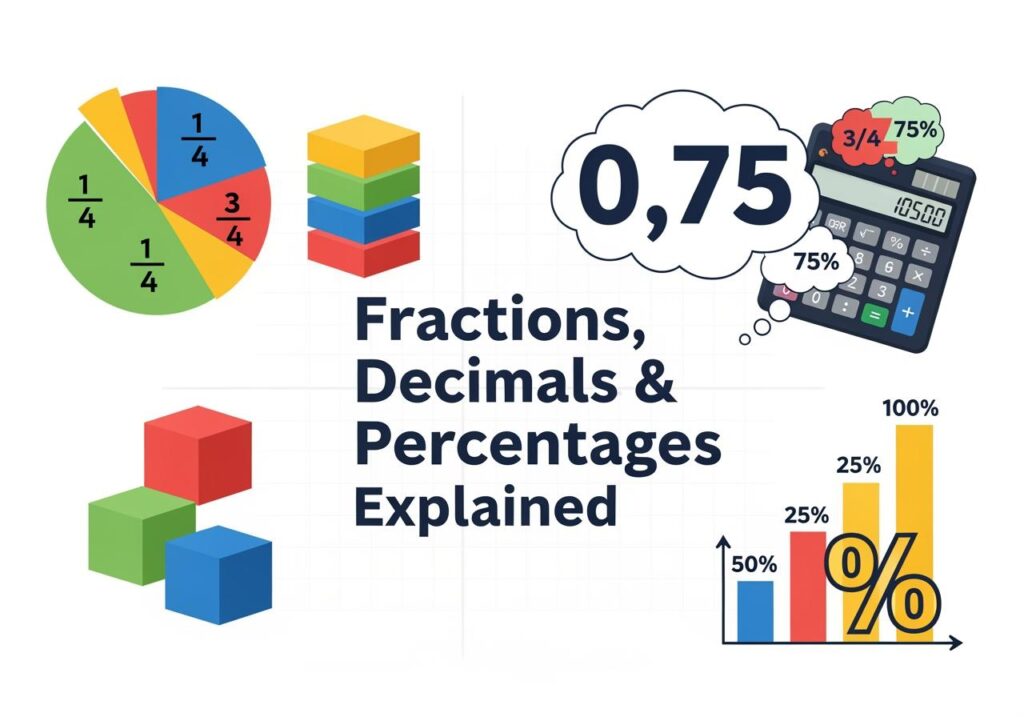
A fraction, a decimal and a percentage can name the same amount. Percent means “per hundred”; the whole is $1=100[[%]]$
$[[frac{3}{4}]]=0.75=75[[%]]$
Fractions and decimals
Fraction to decimal
Step 1
Divide the numerator by the denominator. The fraction bar means division.
$[[frac{3}{8}]]=3[[div]]8$
Step 2
$3[[div]]8=0.375$
Check by multiplying back:
$0.375[[times]]8=3$
Decimal to fraction
Step 1
Count decimal places. Three decimal places mean thousandths.
$0.125=[[frac{125}{1000}]]$
Step 2
Divide numerator and denominator by their greatest common factor, $125$
$[[frac{125}{1000}]]=[[frac{1}{8}]]$
Do not put every decimal over a hundred. The last digit here is in the thousandths column.
Percent means per hundred
Decimal to percentage
Step 1
Multiply the decimal by a hundred to find the percentage number.
$0.375[[times]]100=37.5$
Step 2
Attach the percent sign to that number.
$0.375=37.5[[%]]$
The percent sign changes the unit: $0.375[[times]]100=37.5[[%]]$ is not a valid equality.
Percentage to decimal
Step 1
Divide the percentage number by a hundred. This works even when it is smaller than one.
$0.5[[%]]=[[frac{0.5}{100}]]$
Step 2
$[[frac{0.5}{100}]]=0.005$
Check: $0.005[[times]]100=0.5$ Half of one percent is not half of the whole.
Fraction to percentage
Step 1
Divide, then multiply by a hundred to find the percentage number.
$[[frac{3}{5}]]=0.6$
Step 2
$0.6[[times]]100=60$
Step 3
$[[frac{3}{5}]]=60[[%]]$
Alternatively, make an equivalent fraction with denominator $100$:
$[[frac{3}{5}]]=[[frac{60}{100}]]$
Percentage to fraction
Step 1
Write the percentage number over a hundred.
$12.5[[%]]=[[frac{12.5}{100}]]$
Step 2
Multiply both parts by ten to remove the decimal, then simplify.
$[[frac{12.5}{100}]]=[[frac{125}{1000}]]$
Step 3
$[[frac{125}{1000}]]=[[frac{1}{8}]]$
Multiplying only the numerator would change the value.
Above one and exact answers
More than one whole
Step 1
Convert the mixed number to an improper fraction.
$1[[frac{1}{4}]]=[[frac{5}{4}]]$
Step 2
Divide, then express the result per hundred.
$[[frac{5}{4}]]=1.25$
Step 3
$1.25[[times]]100=125$
Step 4
$1[[frac{1}{4}]]=125[[%]]$
A percentage can exceed a hundred. In reverse, $125[[%]]=[[frac{125}{100}]]=[[frac{5}{4}]]$; split off one whole for the mixed number.
Zero also has all three forms: $[[frac{0}{1}]]=0=0[[%]]$
A recurring value is not a rounded value
Step 1
An overbar marks digits that repeat forever. Here only the digit three repeats.
$[[frac{1}{3}]]=0.[[overline{3}]]$
Step 2
Keep the recurring percentage for an exact answer.
$[[frac{1}{3}]]=33.[[overline{3}]][[%]]$
Step 3
If asked for one decimal place in the percentage, use an approximation sign.
$33.[[overline{3}]][[%]][[approx]]33.3[[%]]$
The equals sign means exactly equal. A finite $33.3[[%]]$ is slightly smaller than a third. Keep exact values until the final rounding step. The next lesson explains how repeating decimals become fractions.
Practice Problems
Try each question on paper before opening its answer. Give fractions in simplest form and keep exact values unless rounding is requested.
Practice 1
Convert $[[frac{7}{8}]]$ to a decimal.
Show answer
$7[[div]]8=0.875$
Divide the numerator by the denominator, not the other way round.
Practice 2
Convert $0.045$ to a fraction in simplest form.
Show answer
$0.045=[[frac{45}{1000}]]$
$[[frac{45}{1000}]]=[[frac{9}{200}]]$
Three decimal places mean thousandths, not hundredths.
Practice 3
Write $1.08$ as a percentage.
Show answer
$1.08[[times]]100=108$
$1.08=108[[%]]$
A value above one gives a percentage above a hundred.
Practice 4
Write $0.25[[%]]$ as a decimal.
Show answer
$0.25[[div]]100=0.0025$
$0.25[[%]]=0.0025$
The percentage number must be divided by a hundred.
Practice 5
Write $[[frac{9}{20}]]$ as a percentage.
Show answer
$[[frac{9}{20}]]=[[frac{45}{100}]]$
$[[frac{9}{20}]]=45[[%]]$
An equivalent fraction needs both parts multiplied by the same number.
Practice 6
Write $2.5[[%]]$ as a fraction in simplest form.
Show answer
$2.5[[%]]=[[frac{2.5}{100}]]$
$[[frac{2.5}{100}]]=[[frac{25}{1000}]]$
$[[frac{25}{1000}]]=[[frac{1}{40}]]$
Do not round a small percentage to a whole number.
Practice 7
Order $0.58$, $[[frac{3}{5}]]$ and $59[[%]]$ from smallest to largest.
Show answer
$[[frac{3}{5}]]=0.6$
$59[[%]]=0.59$
$0.58<0.59<0.6$
Use one representation before comparing.
Practice 8
A bottle contains $0.75$ litres out of a capacity of $1.25$ litres. What percentage is full?
Show answer
$[[frac{0.75}{1.25}]]=[[frac{3}{5}]]$
$[[frac{3}{5}]]=60[[%]]$
Divide the amount by the capacity first; the amount alone is not the fraction full.
Practice 9
A learner writes $[[frac{1}{3}]]=33.3[[%]]$ Correct the statement for an exact answer and for a percentage rounded to one decimal place.
Show answer
$[[frac{1}{3}]]=33.[[overline{3}]][[%]]$
$[[frac{1}{3}]][[approx]]33.3[[%]]$
A recurring decimal does not stop at the last printed digit.
Interactive Quiz
Exit check: Choose an answer, then explain your method before opening the review.
1. Which decimal equals $1.5[[%]]$?
2. Which exact value equals $1[[frac{3}{5}]]$?
3. Which statement is exact?
Review the exit quiz
Question 1: B. Divide by a hundred, not ten.
$1.5[[%]]=0.015$
Question 2: C. Convert the whole mixed number, including its whole part.
$1[[frac{3}{5}]]=1.6=160[[%]]$
Question 3: A. The overbar keeps the infinite repetition. B is only a rounded approximation; C cuts off the decimal.
Without looking back, explain why changing from a decimal to a percentage changes the number written but not the represented amount.