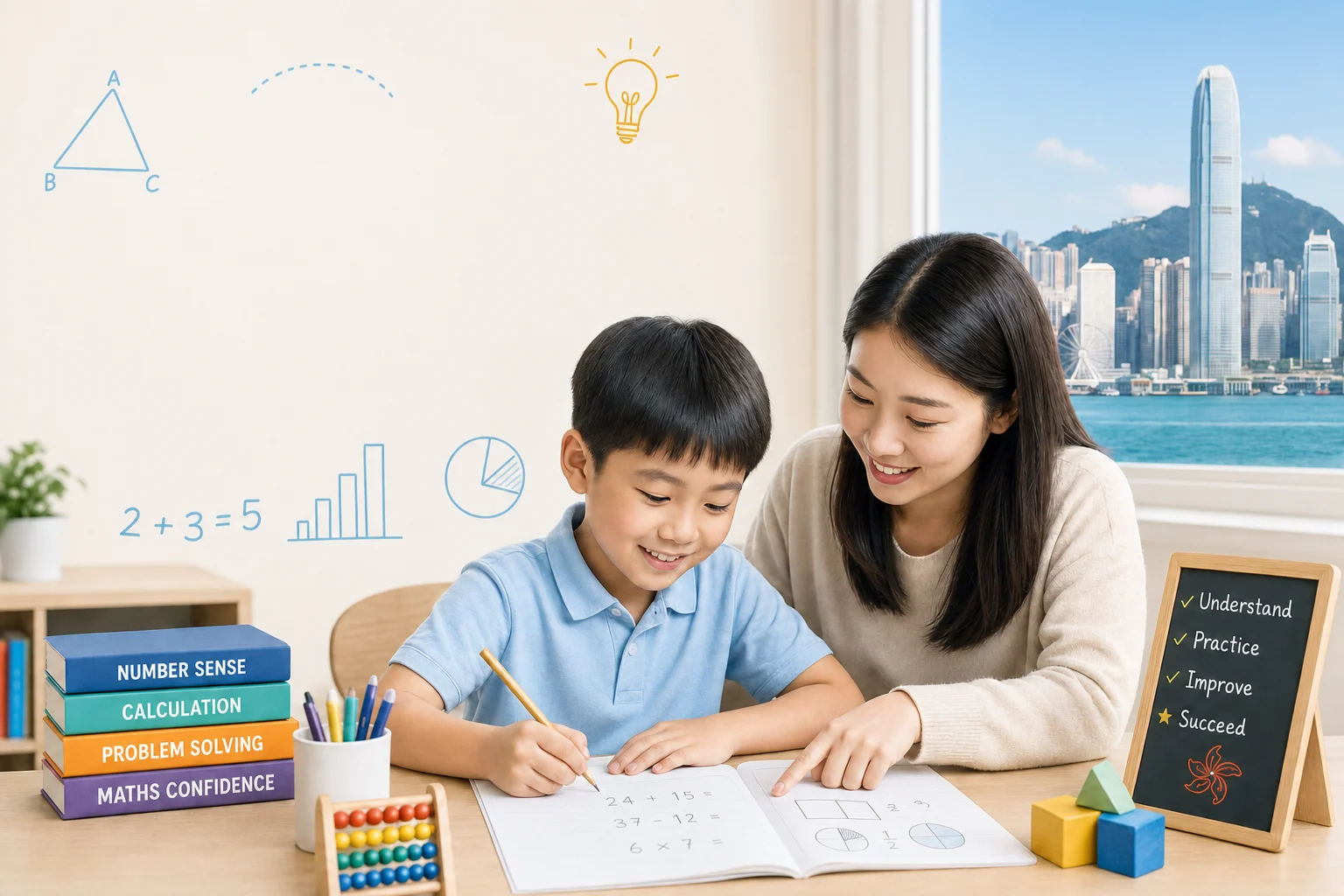

Our results speak for themselves: 95% of our students score 45 to 50 (out of 50) in Cambridge Primary Checkpoint tests. Behind every one of those results is a child who developed genuine number sense, real problem-solving ability, and the confidence to tackle challenging questions independently.
Why Early Support Builds Lifelong Confidence
Early gaps in mathematical understanding do not simply stay the same — they grow. Strong number sense in the primary years is a reliable predictor of long-term mathematical proficiency, and research highlights performance gaps rooted in foundational skills — subitising, counting, and basic number operations — that require targeted intervention before they harden into lasting misconceptions [Yang & Sianturi, 2017]. The earlier these are addressed, the easier every subsequent stage of mathematics becomes.
Our educators are selected for their ability to deliver results — combining deep subject mastery with a genuine talent for making mathematics click for young learners. Many of our tutors deliver a quality of instruction that surpasses what most trained classroom teachers can offer, precisely because they focus entirely on the individual child in front of them. They are specialists in international curricula including IB PYP, Cambridge Primary, and Common Entrance — they know exactly what these programmes demand and how to prepare students to meet those demands confidently.
Word problems are a near-universal challenge. As Francky Cheung observes: “Every single primary student I’ve worked with struggles with worded problems — it’s the one area that consistently holds children back.” Solving word problems requires breaking down complex information systematically, a skill most children simply do not develop without structured guidance [Pfannenstiel et al., 2015]. Our tutors teach reading comprehension strategies adapted for mathematical contexts, visual representation methods such as bar modelling, and step-by-step solution frameworks that develop logical thinking progressively. Research consistently shows that bar modelling significantly improves students’ understanding and problem-solving abilities — helping children visualise mathematical problems before they attempt to solve them [Bar Model Study, 2022].
How the Right Tutor Transforms a Struggling Student
We work primarily with students from international and ESF schools across Hong Kong, tailoring every programme to the individual. Groups are formed only where students share similar ability levels, ensuring that no child is held back or left behind. We use an extensive library of textbooks, digital tools, and proprietary resources to create worksheets matched precisely to each child’s needs and current level.
At primary level, regular practice is essential — but it does not have to feel like a chore. Our online resources are designed so that students feel they are progressing through a game, with each completed exercise unlocking the next challenge. This approach keeps children genuinely engaged while quietly building the fluency and speed they need.
One of our students, Cameron, aged 8, arrived struggling with poor number sense and unable to recall his times tables. By presenting the same concepts repeatedly through varied formats and game-based exercises, he progressed with far less resistance than anyone expected — and more importantly, his entire relationship with mathematics changed. Research supports this: building intrinsic motivation and a sense of progress are strong predictors of sustained engagement in mathematics [Yeo et al., 2021]. Our tutors actively develop this resilience alongside academic skills, so students do not just improve their grades — they genuinely start to enjoy the subject.
We give particular focus to number arithmetic — fractions, decimals, percentages, highest common factor, and lowest common multiple — cycling through these topics repeatedly at increasing levels of difficulty. This ensures that the foundational concepts underpinning secondary algebra and geometry are genuinely mastered, not just memorised for the next test, and that students are well prepared for the significant step up to IGCSE Mathematics and IB Mathematics.
Preparing for Secondary School and Beyond
The transition from primary to secondary mathematics is a major cognitive leap, and students who arrive in secondary school with shaky foundations often struggle more than necessary. Our tutors focus specifically on this transition — identifying any gaps and closing them before they become obstacles in secondary school.
The long-term results are consistent: 90% of students who continue with Interactive Tutors into secondary school achieve A*/A in IGCSE Mathematics and score 6 or 7 in IB Mathematics. Students attending weekly 60-minute sessions typically achieve 30% better assessment scores within a single term, along with lasting improvements in mathematical confidence, problem-solving ability, and readiness for A-Level Mathematics, SAT, and beyond. IB research confirms that students enrolled in structured, inquiry-led mathematics programmes from the primary years significantly outperform their peers on global benchmarks [IBO, 2026].
Frequently Asked Questions
What should I look for in a primary maths tutor in Hong Kong?
Qualifications matter, but they do not tell the whole story. What truly defines an outstanding primary maths tutor is the ability to explain complex concepts clearly, adapt to how each child thinks, and build genuine confidence. Look for someone with proven experience in international curricula — IB PYP, Cambridge Primary, Common Entrance — and a track record of results. At Interactive Tutors, we select our educators based on demonstrated teaching ability and subject mastery, and their results consistently speak for themselves.
How quickly will my child show improvement?
Most students show noticeable progress within 8 to 12 weeks of regular weekly tutoring. Our data shows that students attending weekly 60-minute sessions achieve 30% better assessment scores within one term, with benefits extending well beyond mathematics into broader critical thinking and study habits across all subjects.
How do you help with word problems?
We teach a structured approach that combines reading comprehension strategies adapted for mathematical contexts, bar modelling and other visual tools, and logical step-by-step solution frameworks. Research shows that students who use bar modelling consistently improve their word problem accuracy significantly within a few months, while developing analytical thinking skills that carry across every subject they study [Bar Model Study, 2022].
Start Your Child’s Mathematical Journey Today
Strong primary mathematics skills create academic advantages that last well beyond primary school — through IGCSE, IB, SAT, A-Levels, and university admissions. Book a free consultation with our qualified primary maths tutors in Hong Kong. We will identify your child’s specific needs and build a personalised learning plan that lays the foundation for genuine, lasting academic success.
References
- Yang, D. C., & Sianturi, I. A. (2017). An analysis of Singaporean versus Indonesian textbooks based on trigonometry content. International Journal of Science and Mathematics Education, 15(8), 1423–1441.
- Pfannenstiel, K. H., Bryant, D. P., Bryant, B. R., & Porterfield, J. A. (2015). Cognitive strategy instruction for teaching word problems to primary-level struggling students. Intervention in School and Clinic, 50(5), 291–296.
- Bar Model Study (2022). The effects of bar model in the students’ performance in solving word problems. De La Salle University Repository. Retrieved from animorepository.dlsu.edu.ph
- Yeo, L. S., et al. (2021). Perseverance, effort, and mathematical engagement during school disruptions. Educational Psychology Review.
- International Baccalaureate Organization (2026). PYP and MYP students outperform peers on global benchmarks. IBO News. Retrieved from ibo.org