
At a glance
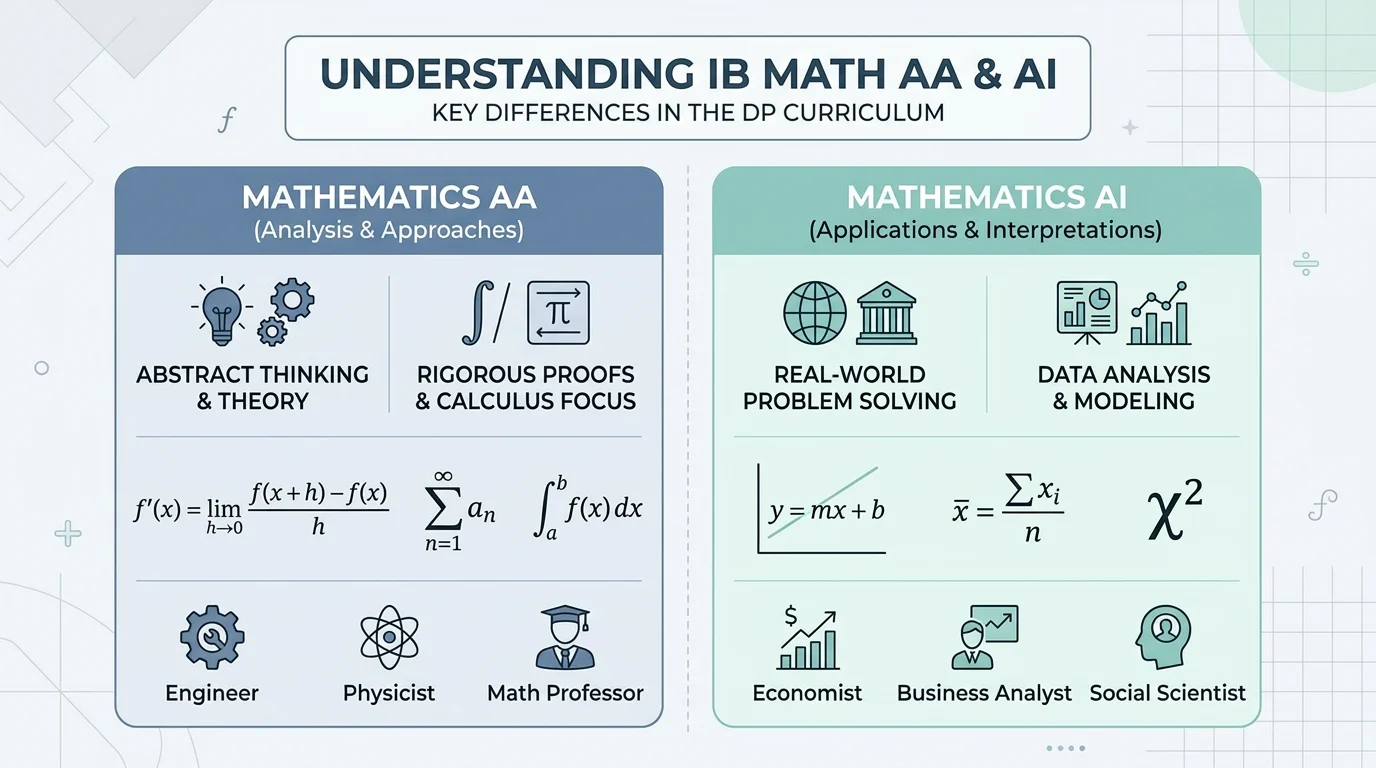
- AA = calculus, algebra, and proofs — Paper 1 is non-calculator.
- AI = statistics, modelling, and technology — calculator allowed on every paper.
- Hours: SL 150 · HL 240 (both pathways). HL adds a third exam paper.
- University entry: Check the exact degree, entry year and accepted mathematics course and level.
Should I choose IB Math AA or AI?
- Choose AA if you enjoy algebra, calculus and abstract problem-solving, or if a degree you’re considering requires AA.
- Choose AI if you prefer statistics, modelling and using technology to solve problems. Check that your target degree accepts the AI level you plan to take.
- Check the exact degree and entry year before choosing SL or HL. Requirements can differ between degrees at the same university.
Curriculum update: The revised IB mathematics curricula begin teaching in August 2027, with first assessment in May 2029. Check the subject brief for your exam session.
What Is the Difference Between IB Math AA and AI?
The two courses were introduced in 2021 to replace the old IB Math HL, SL, and Math Studies programmes. They share a common foundation but diverge significantly in depth, emphasis, and exam structure.
| Feature | Math AA | Math AI |
|---|---|---|
| Primary focus | Calculus, algebra, pure maths | Statistics, probability, modelling |
| Technology use | No calculator on Paper 1 | Calculator permitted on all papers |
| Best suited for | Engineering, physics, mathematics | Economics, psychology, design |
| Teaching style | Proofs and theoretical frameworks | Project-based, data-driven tasks |
For a detailed breakdown of the AA syllabus, see our IB Math AA programme page.
Should You Choose HL or SL?
Both pathways are offered at Standard Level (SL) and Higher Level (HL). SL requires 150 guided learning hours; HL requires 240 hours and includes a third exam paper with more advanced content. The jump from SL to HL is significant — HL students encounter complex numbers, further calculus, and multi-step abstract proofs that go well beyond the SL syllabus.
Choosing HL means accepting a heavier workload across an already demanding six-subject programme, so it is worth mapping out your realistic weekly study hours before committing.
Hong Kong Enrollment Statistics
The IB does not publish a Hong Kong-specific AA vs AI breakdown, but we can estimate local numbers by applying the May 2025 global subject split to Hong Kong’s total of 2,630 IB candidates that session.
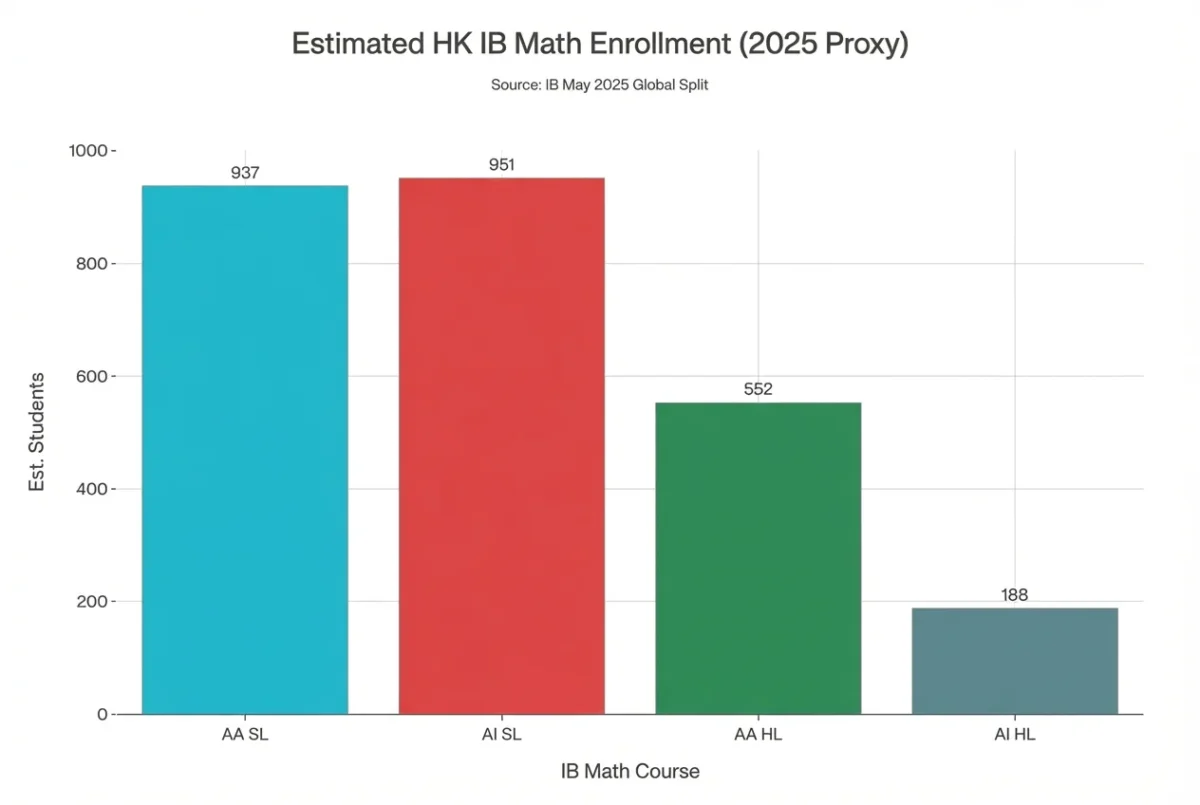
- Math AI SL is the most popular option globally at roughly 36.2% of entries — an estimated 952 students in Hong Kong.
- Math AA SL follows closely at 35.6% — an estimated 936 students.
- Math AA HL accounts for 21.0% of entries, making it the dominant HL choice for STEM-focused students — an estimated 552 students.
- Math AI HL remains the least common at just 7.2% of entries — an estimated 189 students across Hong Kong.
The Rise of Math AI HL
IB Math AI HL is still the least commonly chosen of the four options, largely because many schools and families default to more traditional pathways when targeting highly selective universities. However, this is beginning to change in Hong Kong.
Having taught IB Mathematics since the new syllabuses launched in 2021, I witnessed this shift first-hand. I had no AI HL students at all in that first year — the course was new and few families knew enough about it to seek it out specifically. My first AI HL enquiries came in 2022, and demand has grown steadily every year since. What stands out is that families are now actively asking for a tutor who specialises in AI HL rather than defaulting to an AA HL tutor — a sign of growing awareness that the two courses require genuinely different expertise. AI HL is heavier on statistics, modelling, and technology use than anything in the traditional IB curriculum, and it rewards a different kind of mathematical thinking. For a full breakdown of what the course involves, see the IB Math AI programme page.
What to Expect in Each Course (and What the Papers Feel Like)
Students who have completed both routes often say the difficulty gap between AA and AI is smaller than expected — especially at Higher Level, where both demand sustained, rigorous problem-solving. The feel of the papers, though, is quite different.
In an AA classroom
You will spend more independent time on algebraic manipulation and formal proofs. Mental arithmetic and precise hand-worked algebra matter from day one because Paper 1 is non-calculator.
| Paper | What it feels like (AA) |
|---|---|
| Paper 1 | No GDC. Short- and longer-response questions that punish shaky algebra. If you cannot rearrange expressions cleanly by hand, this paper hurts. |
| Paper 2 | GDC allowed. Still heavy on functions, calculus, and multi-step reasoning — the calculator helps with computation, not with knowing which method to use. |
| Paper 3 (HL only) | Extended problem-solving / investigation style. You dig into an unfamiliar situation with several linked parts; stamina and structure matter as much as content. |
| IA | Often explores a pure idea — extending a theorem, a number-theory property, or a geometric result. Clarity of mathematical communication counts. |
In an AI classroom
Lessons tend to be collaborative and technology-driven: GDC, spreadsheets, regression, and real data sets from early on. You practise translating a messy real-world prompt into a model, then interpreting the output.
| Paper | What it feels like (AI) |
|---|---|
| Paper 1 | GDC permitted (unlike AA). Still timed and technical — calculator fluency is an advantage, not a free pass. |
| Paper 2 | Longer modelling and statistics-heavy tasks. Command words and clear communication of assumptions matter. |
| Paper 3 (HL only) | Extended investigation / modelling. Graph theory, further stats, or multi-stage models often appear; you need a plan before you dive into the GDC. |
| IA | Typically applied — population growth, sports data, logistics, finance. Strong IAs show a clear research question, appropriate maths, and honest evaluation of the model’s limits. |
Neither route is “the easy option.” Pick the one whose daily work and exam style match how you already like to think.
Which Course Suits You? A Quick Decision Guide
Answer these four questions to narrow down your best option:
- Do you enjoy mathematical proofs and abstract problem-solving?
Yes → lean towards AA. No → lean towards AI. - Does your target university programme require Math AA HL?
Yes (engineering, physics, maths degrees) → choose AA HL. No → continue below. - Do you prefer working with data, statistics, and real-world contexts?
Yes → AI is likely the better fit. No → AA may still suit you better. - How heavy is the rest of your IB subject load?
Already taking 3 HL subjects with heavy workloads → consider whether SL gives you enough breathing room to maintain strong grades across all six subjects.
Still unsure? Book a free consultation with one of our IB specialists — we will help you map out the best combination based on your university goals and strengths.
Common Misconceptions About AA vs AI
A few ideas circulate in WhatsApp groups and school corridors that quietly push students toward the wrong course. Worth clearing up before you lock in your subject choices.
“AI is always easier.”
Not at Higher Level. AI HL still demands sustained problem-solving, heavy statistics, and confident technology use. Students who pick AI HL mainly to avoid difficulty often find Paper 3 and the modelling questions harder than they expected. Choose AI because the style of maths fits you — not because it sounds softer.
“Any HL maths is fine for engineering.”
Check each engineering programme’s admissions page. Some specify AA HL, and the required mathematics grade can vary by programme and entry year.
“I can switch mid-year if I hate it.”
Technically possible, but disruptive. The syllabuses diverge from the first weeks — proofs and non-calculator algebra in AA versus data, GDC work, and modelling in AI. Catching up after a late switch eats into other HL subjects. Decide before Year 1 starts; talk to your IB coordinator early if you are already unsure.
University Entry Requirements
IB Mathematics expectations differ by programme. These examples show how universities specify the course and level.
| Degree programme | Published IB mathematics expectation |
|---|---|
| HKUST BBA in Economics | AA SL or HL Mathematics is normally expected. |
| HKUST BSc in Quantitative Finance | HL Mathematics is normally expected. |
| LSE BSc Economics | AA HL is preferred. Both HL streams are considered. |
| LSE BSc Mathematics and Economics | AA HL is required. |
Always verify the specific mathematics requirement for each programme directly on the university’s admissions page before making your final choice — requirements can change year to year.
Students currently in Years 9–11 preparing for IGCSE before entering the IB Diploma Programme can find detailed preparation guidance on our IGCSE maths tutoring page.
If you have already chosen AA or AI and want structured support — past papers, IA guidance, or HL Paper 3 practice — our IB Maths tutoring is built around both pathways at SL and HL. A short conversation is usually enough to map where you are and what to prioritise next.
Unsure which course is the right fit for your target degree? Book a free consultation and get personalised advice based on your goals.
Explore Related Programmes
Many IB students in Hong Kong also prepare for additional exams alongside their diploma:
- IGCSE Mathematics — for students in Years 10–11 preparing to enter the IB Diploma Programme
- A-Level Mathematics — a common alternative pathway for UK university applicants
- SAT Math — required alongside IB for many US university applications
- AP Calculus — some IB students take AP exams for additional college credit